GE HealthCare Ultrasound Comparison: Voluson vs. Logiq Series
Introduction
In the realm of diagnostic medical sonography, GE HealthCare stands as a titan, offering a diverse portfolio of ultrasound systems tailored to specific clinical needs.
For healthcare facilities and private practices, the choice often narrows down to two flagship series: the Voluson and the Logiq.
While both product lines share GE’s heritage of imaging excellence and durability, they are engineered with fundamentally different philosophies and target audiences in mind.
Understanding the nuances between these two series is critical for hospital administrators and clinicians to maximize return on investment and clinical efficacy.
This article provides a professional, deep-dive comparison of the GE Voluson and GE Logiq families, dissecting their technological architectures, clinical strengths, and ideal use cases.
1. Core Clinical Philosophy: Specialization vs. Versatility
The most significant differentiator between the Voluson and Logiq series is their intended clinical application.
The Voluson series is explicitly designed for Women’s Health.
It is the global standard for Obstetrics and Gynecology (OB/GYN), focusing heavily on fetal assessment, maternal health, and reproductive medicine.
Every aspect of the Voluson, from its beamforming algorithms to its user interface, is optimized to image the fetus and female reproductive anatomy.
In contrast, the Logiq series represents GE’s General Imaging and Radiology solution.
The Logiq is engineered for versatility, capable of performing high-quality scans across a wide spectrum of disciplines including abdominal, vascular, musculoskeletal (MSK), small parts, and interventional radiology.
While a Logiq machine can perform an obstetrics scan, and a Voluson can scan a liver, using them outside their primary domain often results in a less efficient workflow and suboptimal image rendering for that specific pathology.
2. The Voluson Series: Unrivaled in Obstetrics and Gynecology
The Voluson line, including the high-end E-series (Expert), the S-series (Signature), and the P-series (Performance), is synonymous with volumetric imaging.
3D/4D Imaging Capabilities
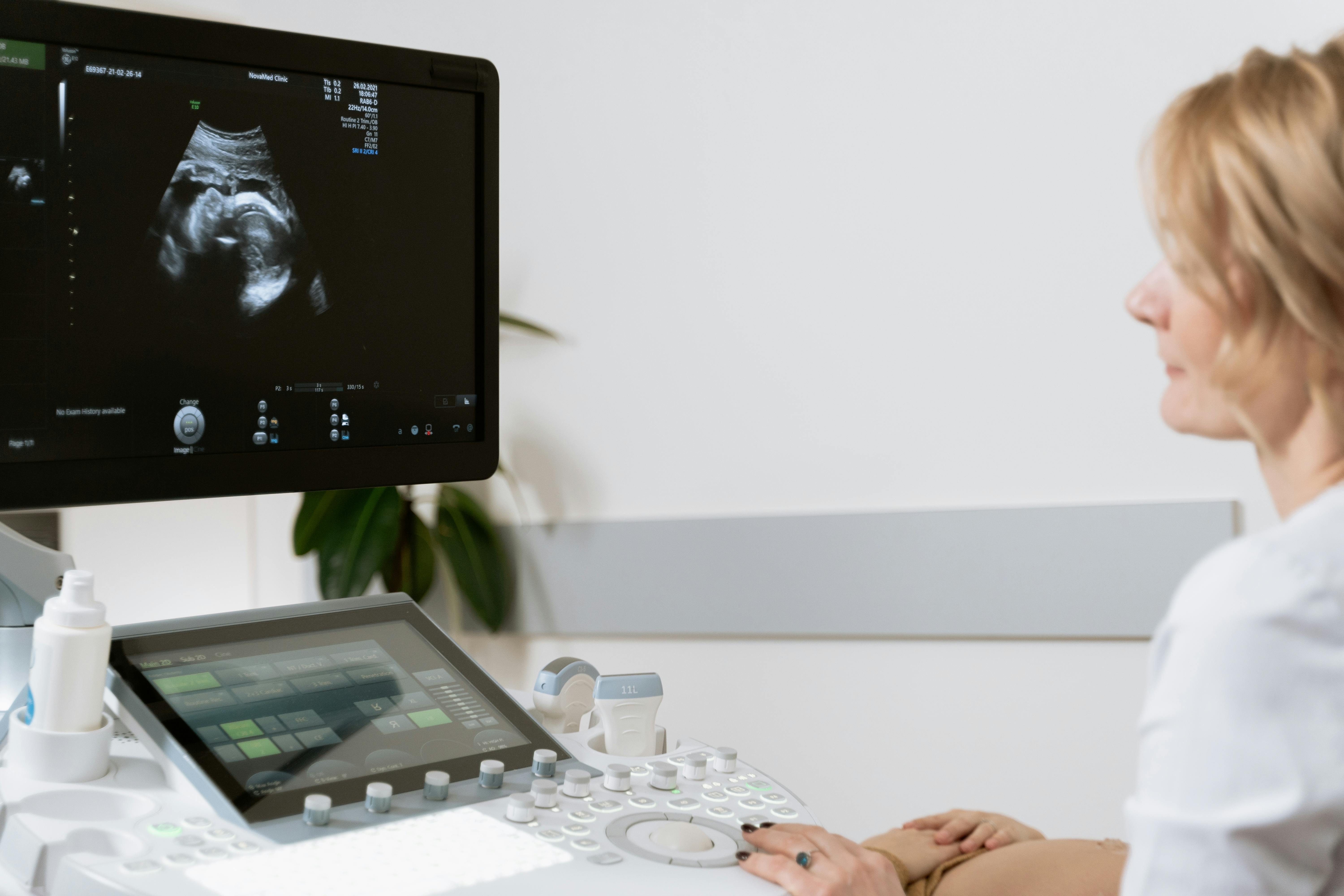
Voluson systems are the market leaders in 3D (static volume) and 4D (real-time volume) imaging.
The proprietary HDlive technology provides exceptional realism in fetal imaging, using a virtual light source to cast shadows and create depth perception.
This is not merely for aesthetic bonding between parents and the fetus; it is a critical diagnostic tool for assessing cleft lips, spinal defects, and limb abnormalities.
The rendering engines in Voluson machines are tuned to process the rapid frame rates required to capture fetal movement clearly.
Automated Biometry and Workflow
To support high-volume OB practices, Voluson integrates advanced automation tools such as SonoBiometry.
This feature automatically places calipers for BPD, HC, AC, and FL measurements, significantly reducing keystrokes and exam time.
Furthermore, specialized features like SonoVCAD (Sonography-based Volume Computer Aided Display) help in the automated acquisition of standard heart views, assisting in the early detection of congenital heart defects.
Gynecological Applications
Beyond obstetrics, the Voluson excels in gynecology with specialized endocavitary probes.
Technologies like TUI (Tomographic Ultrasound Imaging) allow clinicians to view volume data in simultaneous parallel slices, similar to CT or MRI.
This is invaluable for assessing uterine anomalies, IUD placement, and ovarian pathologies.
3. The Logiq Series: The Radiologist’s Workhorse
The Logiq series, spearheaded by the flagship E10 and E9, focuses on raw data processing and full-body diagnostic confidence.
XDclear Probe Technology
A hallmark of the premium Logiq systems is the use of XDclear transducer technology.
These single-crystal probes offer a wider bandwidth, providing both deep penetration for difficult-to-scan patients and high resolution for superficial structures.
This is particularly important in general radiology where patient body habitus varies significantly, and deep abdominal imaging is routine.
Advanced Elastography
While Voluson has some elastography features, the Logiq series offers a comprehensive suite of Shear Wave Elastography.
This allows for the quantitative assessment of tissue stiffness, a critical parameter in liver fibrosis staging and the characterization of breast and thyroid nodules.
For a radiology department, the ability to provide non-invasive liver stiffness quantification is a major revenue driver and clinical necessity.
Interventional and Vascular Features
Logiq systems are often the preferred choice for interventional procedures.
Features like Needle Recognition enhance the visualization of the needle tip during biopsies and injections.
Additionally, B-Flow technology allows for the non-Doppler visualization of blood flow hemodynamics.
This is superior to standard Color Doppler for assessing complex vascular structures, such as carotid artery stenosis or renal perfusion, without the artifacts of blooming or wall motion.
4. Hardware and User Interface Differences
The physical design and user experience of the two systems reflect their distinct workflows.
The Console Layout
The Voluson interface is designed around the "knobology" of OB/GYN exams.
It features dedicated trackball functions for manipulating 3D volumes (x, y, and z-axis rotation) and hardware buttons specifically for volume acquisition modes.
The Logiq interface, conversely, prioritizes mode switching between B-mode, Color, and Doppler, facilitating the rapid screening protocols common in radiology.
Logiq consoles often feature a large touch panel that allows for customizable digital presets, enabling a technician to switch from a thyroid exam to a renal artery Doppler in seconds.
Probe Compatibility
While both systems use the same connector types in many generations, the probe optimization differs.
- Voluson Probes: Heavy emphasis on mechanical 3D/4D convex and endocavitary probes. These probes are often larger and heavier due to the motor mechanism inside.
- Logiq Probes: Emphasis on high-frequency linear probes (hockey stick, wide footprint) for MSK and small parts, and phased array probes for basic cardiac assessment.
5. Choosing the Right System for Your Practice
Selecting between a Voluson and a Logiq depends entirely on the case mix of the medical facility.
Scenario A: The Specialized OB/GYN Clinic
If the facility's caseload is more than 70% obstetrics and gynecology, the Voluson is the unequivocal choice.
The efficiency gained from automated fetal measurements and the diagnostic confidence provided by 3D/4D uterine imaging cannot be matched by a general imaging system.
Furthermore, the marketing value of "4D Baby Scans" is a significant consideration for private practices.
Scenario B: The Hospital Radiology Department
For a general hospital department scanning abdomens, thyroids, breasts, vascular systems, and pediatrics, the Logiq is essential.
Its ability to handle contrast-enhanced ultrasound (CEUS) and shear wave elastography makes it a versatile diagnostic tool.
Using a Voluson for a dedicated vascular or MSK list would be frustrating due to the lack of optimized presets and specialized analysis packages.
Scenario C: The Shared Service Environment
For smaller rural clinics or emergency rooms where one machine must do it all, the decision is more nuanced.
If the priority is ruling out ectopic pregnancy and fetal viability, a mid-range Voluson might be preferred.
However, if the machine must also perform echocardiography, DVT studies, and abdominal pain assessments, a high-end Logiq with a shared service package is likely the more prudent investment.
Conclusion
Both the GE Voluson and GE Logiq series represent the pinnacle of ultrasound engineering, yet they serve different masters.
The Voluson is the specialist, offering depth and precision in Women's Health that transforms the management of pregnancy and gynecological pathology.
The Logiq is the generalist, offering breadth and power across the entire human anatomy, equipping radiologists with the tools to diagnose complex systemic conditions.
By aligning the equipment choice with the specific clinical mission of the healthcare provider, facilities can ensure diagnostic accuracy, workflow efficiency, and superior patient care.