A Passing Leak Test Is Not a Dry Scope: Fluid Ingress in Flexible Endoscopes
Same symptom on your system?
Tell us your model and what it is doing. A GEPROBE engineer replies with a diagnosis path, part options and pricing — usually within 6 hours, with no obligation.
Chat on WhatsApp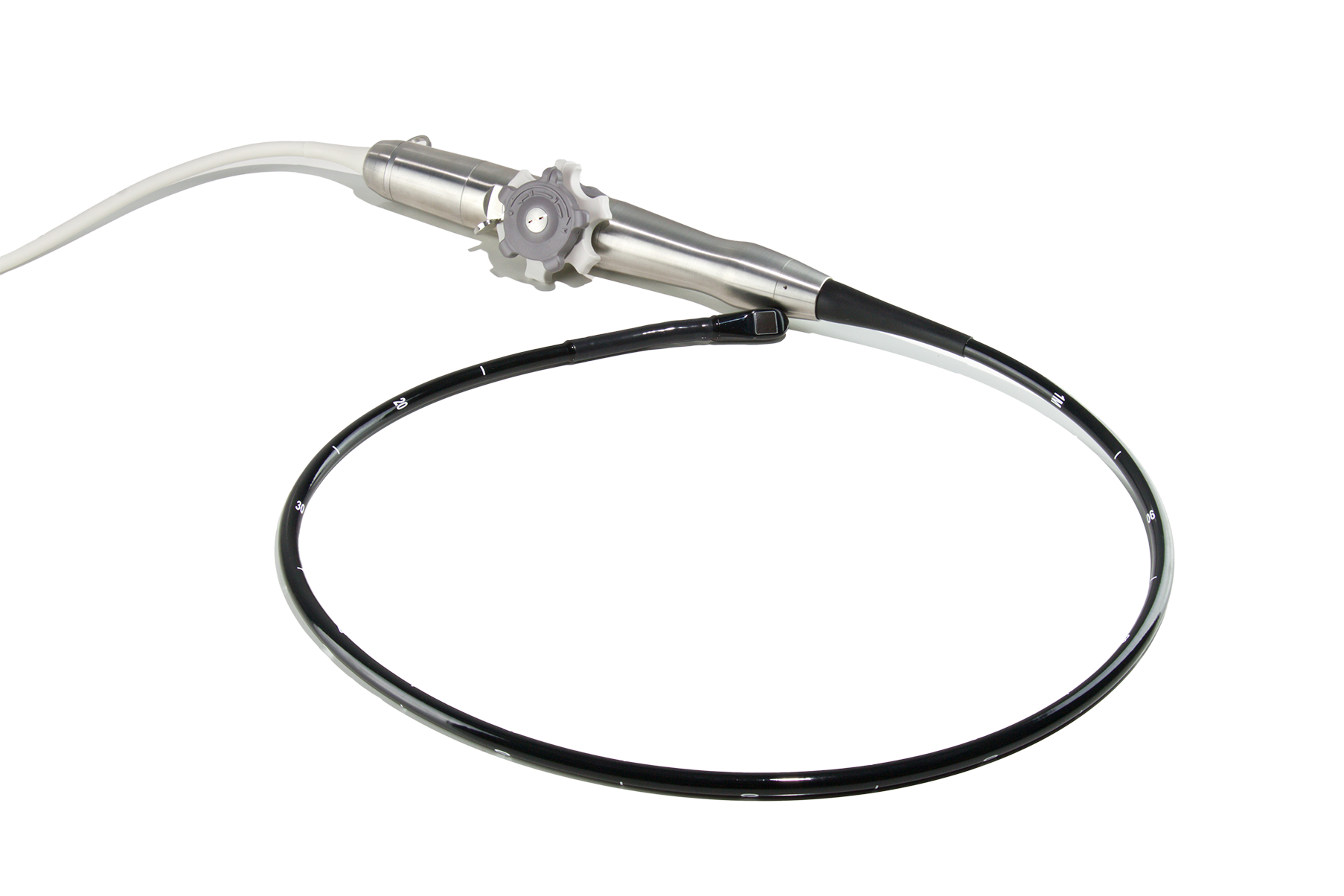
The result that ends the investigation too early
A flexible endoscope comes out of reprocessing and nobody is certain it is dry inside. The leak test is run — it is what the department has, and it is what the manufacturer's instructions specify. The result is normal. The scope goes back into the schedule.
Everything downstream of that moment rests on an assumption worth pulling out and looking at on its own: that a leak test is a test for water.
It is not. A leak test asks whether air can escape from a pressurized scope. That is a narrower question than the one being put to it, and there are documented circumstances in which the two answers come apart completely — where the scope is already holding liquid and the test is clean. This article is about those circumstances, and about the one decision downstream of them that cannot be taken back.
A note on who this is for, because it changes how to read the rest. It is written for the people who own this decision — endoscopy unit managers, reprocessing leads, biomedical engineering — and not as a repair procedure or as clinical guidance. Nothing here replaces the manufacturer's instructions for use or your local reprocessing standard; where those differ from this page, they govern.
What a leak test actually asks
The test is a pressurization test. The scope's internal volume is sealed and pressurized, the scope is immersed, and the operator watches for a continuous stream of bubbles from a single point — the signature of air escaping through a breach. Manufacturers specify the pressure, and they do not agree on it: Olympus specifies its MB-155 leak tester to sit in a green zone of 19–27 kPa and states a hard ceiling of 27 kPa, Pentax specifies a green zone that must never be exceeded, and other testers are specified in the 120–180 mmHg range.
Two features of the procedure define what its result can mean.
The first is that bubbles are not the only criterion. Gauge behavior is a second and independent one: Karl Storz, for example, treats a pressure drop greater than 10 mmHg as a leak. A result read from bubbles alone is a partial result.
The second is that the test's conditions are specified, and the reasons for them are the reasons it can miss things. Manufacturers require clean water, because detergent foam can mask the bubbles being looked for. They require pressurization before immersion, because immersing an unpressurized scope can push water in. They require the bending section to be angulated while submerged, because a leak under the bending rubber can be held shut by the rubber until the section is flexed. Observation time is specified too: Olympus calls for at least 30 seconds, and one published reprocessing paper notes that some leaks take two to three minutes to produce a first bubble.
So the leak test is not a vague check. It is a specific measurement, made under specific conditions, and everything it is capable of telling you is bounded by those conditions.
Olympus, Pentax, Karl Storz, and STERIS are named here as the sources of the specifications quoted. Trademarks belong to their respective owners. geprobe is an independent third-party supplier of medical equipment parts and has no affiliation with, or endorsement from, any of them; nothing in this article is a compatibility statement, a service authorization, or a substitute for the manufacturer's own documentation.
The case where "no leak" is the wrong answer to the question
There is a situation in which the two questions separate cleanly, and it is not exotic.
Liquid does not need a breach to get into a scope. During manual cleaning and reprocessing, if a cap is fitted incorrectly, fluid can be introduced through the port itself. The cap that matters most here is the venting cap used for ethylene oxide sterilization, which manufacturers require to be removed before leak testing, cleaning, and disinfection — leaving it in place during immersion is the documented route to major fluid invasion. A scope can take on water and never develop a leak.
Now consider where the leak tester connects. To a leak-test connector on the port assembly — the same venting path.
This is not our inference, and it is not a hypothetical. It is the stated motivation behind a family of endoscope integrity-testing patents — the filings behind instruments that sample the air inside a scope and measure its humidity rather than only asking whether it holds pressure. The language in those filings is unusually direct:
"even if there is no leak, it does not actually indicate that there is not a problem with the endoscope"
"if a sealing cap or similar structure was not attached correctly during cleaning, fluid may have been introduced internally"
"It is not possible for prior devices to detect this situation."
The test seals the very port through which the water came in. A clean result means the scope held pressure with that port plugged — which is equally true of a scope that took on water through that port.
The honest statement is narrow, and it is the one worth carrying out of this section: a leak test that passed is not a dryness test that passed. If the only thing known about a scope is that its leak test was normal, the fact that actually matters is still unknown.
A test's conditions are not your scope's conditions
The case above is the clean one, where liquid enters without a leak at all. Around it sits a wider family of reasons a leak test can read normal on a damaged scope, and they share a shape: the test creates one set of conditions, and the leak needs a different set.
- The leak is below the test's resolving power. An industry training source puts it plainly — limited test pressure, combined with the self-sealing nature of the polymers used in scope construction, means "a significant percentage of leaks could be missed." An integrity tester's own documentation describes the holes as miniscule and as presenting an extreme challenge to the conventional leak test method.
- The leak is held shut until the scope is moved. This is why angulation during immersion is specified. A scope tested straight can be a scope tested with its leak closed.
- The scope was not pressurized enough. Under-pressurization is documented as a way for a leak to go undiscovered; a slow leak may not move the gauge far enough to be noticed.
- The observation was too short. A leak that takes two to three minutes to produce its first bubble is invisible to a one-minute look.
- Something masked the bubbles. Detergent residue is the documented one.
- The tester is the leak. The instrument has its own seals and connections, and they are not the scope's.
None of this is unique to endoscopes. The gap between the conditions a test creates and the conditions a failure needs is the same gap that makes intermittent ultrasound faults so resistant to diagnosis: a system can pass every check it is given and still fail in service, because the check and the failure are not happening under the same conditions.
Where the liquid goes once it is inside
The intuitive model of a scope is a set of separate sealed sections — insertion tube, control section, umbilical, connector — with a problem staying in the section where it started.
That model is wrong in the direction that matters. A flexible scope has a shared internal cavity running from the insertion tube through the bending section and the control body, along the umbilical, to the connector. Running through that cavity are the full-length bundles and tubes: the light guide bundle, the video signal cable, the air/water channel, the suction and biopsy channels, and the angulation wires.
Liquid entering anywhere in that cavity does not have to remain there. It migrates along the cavity and along the outside of the bundles that run through it, moved by gravity and capillary action. The documented failure reports read exactly like that: a colonoscope returned with fluid invasion reaching the insertion tube, the segment section, the control body, the connector, and the umbilical light guide cable — with severe corrosion inside the control body, damage to the light carrying bundle, and a corroded pin in the connector.
Two corrections to that picture, because the useful part is in the detail.
The liquid travels along the bundles, not inside them. And not every design is fully open: some scopes have sections deliberately sealed against the inner space of the bending portion, and newer designs add dedicated barriers where the video cable, the fiber bundle, and the irrigation tube pass through. The reason those barriers exist is that the migration is real.
The practical consequence is the one that surprises people. An ingress that entered at the distal end can present at the connector, and the corrosion found at the connector is not necessarily where the water came in. For the same failure class in the flexible scope that geprobe sees most often, the entry points and the corrosion pattern are set out in our note on the Philips X7-2t TEE probe.
The one step that cannot be undone
Everything up to this point is recoverable. A scope that has taken on liquid, caught before anything is energized, can be dried, resealed, and returned to service.
Connecting it to the processor is where that stops being true, and the reason is worth stating precisely, because "it might damage the scope" undersells it.
The first consequence is the equipment one. Liquid inside a scope bridges conductors. Manufacturers state it directly: if bubbles emerge continuously during a leak test, the scope is not to be used, because water may enter and cause a short circuit, which may result in image sensor damage. The documented failures follow that path — image sensor unit failure, board failure inside the video connector, corroded connector pins, communication errors. The image sensor is the high-value element in that chain: not uniquely fragile, but the part whose replacement turns a service event into a major repair.
One piece of received wisdom is worth retiring here. The assumption that these scopes are all CCD-based, and that the CCD is the most expensive component in them, is out of date on both counts. CMOS sensors are now standard in flagship scopes and in wide use alongside CCDs, and sensor cost varies enough by model and by service contract that "most expensive part" is not a safe generalization. What is vulnerable is the electronics as a whole, not one chip.
The second consequence is the one that should settle the question. A damaged image sensor that is left powered does not fail quietly. Olympus's own documentation for one scope family states that if there is no endoscopic image, the image sensor may already be damaged, and instructs that the video system center be switched off immediately — because a damaged sensor that continues to receive power heats the distal tip, and that carries a risk of burning the patient or the operator.
That is the asymmetry in a single sentence. The cost of not powering a wet scope is a delay. The cost of powering one is a repair at the top of the price band, and a patient-safety hazard that has nothing to do with whether the scope still produces an image.
We do not publish repair prices, and nothing above is a quotation — the point is the shape of the two outcomes, not their amounts. The practical rule is unconditional: if liquid is confirmed or suspected, the scope does not get connected to the processor. Not to check whether it still works. Not to see how bad it is. The check is what causes the damage.
The signals, and why they arrive late
Two early indicators circulate in the field. Both are worth examining, because one is weaker than people assume and the other is right about the observation and wrong about the cause.
Weight change. That a scope holding liquid weighs more is intuitive, and liquid does change the weight. But weighing has been tested as a dryness check, and a 2026 study in the Journal of Hospital Infection found that weight measurements could only identify a grossly wet endoscope, and could not detect droplets below 10 µL. A balance is a gross-wetness detector, not an early-warning instrument. If a scope has gained weight you can notice, the ingress is not early.
Changes in angulation feel. This one holds up better, with a correction. Sluggishness or clicking in the angulation controls appears among the signs that a scope should be pulled from service, and fluid invasion is one of the recognized causes. What does not hold up is the usual explanation — that ingress dilutes the lubricant and the controls stiffen as a result. In the manufacturer documentation and reprocessing literature reviewed for this article, that mechanism is not described, and the guidance on scope lubrication points the other way: lubricant can swell valve seals and impair function, petroleum-based and silicone lubricants can degrade the rubber, and rough or resistant angulation is a signal to stop using the scope and send it for service — not to add lubricant and carry on.
There is one further check worth knowing, and unlike the venting-cap technique that circulates informally, this one is documented. The venting cap must be removed before leak testing, cleaning, and disinfection, and leaving it in place during immersion is the documented route to major fluid invasion. The adjacent practice sits on the other cap: when the waterproof cap is removed after disinfection, liquid found inside it is a reason to send the scope for service rather than return it to the schedule.
The honest position on early detection is therefore that there is not much of it. The signals arrive once the ingress is established. That is not an argument for watching harder; a scope does not announce this early enough for watching to help. It is an argument for controlling the consequence, because energizing is the only part of the sequence that is still a decision.
What the industry's own patents say about this gap
The clearest confirmation that "leak test passed" and "scope is dry" are two different facts is that manufacturers have spent years patenting instruments to close the distance between them.
Inside the scope: a sealed internal cavity carrying a humidity sensor that triggers an alarm when moisture crosses a threshold, and in one filing starts a pump to pressurize the scope against further ingress. At the distal end: a humidity sensor placed near the leak-proof fitting, reusing existing signal lines so the scope does not get thicker, displaying a leak-detected warning — filed with the explicit purpose of getting the scope to service before the electronics are damaged. Outside the scope: integrity testers that sample internal air for humidity, compare against a threshold, archive the result against the scope's serial number, and flag the instrument so it cannot be returned to the clinical schedule.
None of that would be worth building if a leak test already answered the question.
Most of it is patent and research rather than shipping product. The externally placed testers are the part that has been commercialized; humidity sensing inside the scope is an explored direction rather than a deployed one. But the direction says what the people who build these instruments believe the problem is.
Which brings this back to where it started. A leak test is a good test. It answers a real question, and it is the question the manufacturer's instructions specify. It is simply not the question a scope coming out of reprocessing is being asked to answer. The test result and the dryness of the scope are two different facts, and only one of them is what the next patient case depends on.
geprobe does not guarantee the condition or serviceability of any specific instrument, and nothing here is a diagnosis of one. The narrow point this page can make is that an instrument with confirmed or suspected liquid ingress should not be energized, and that what follows is a service decision rather than a scheduling one.
Fluid ingress and sealing is one of the repair classes geprobe works on — micro-electronics drying, leak-test failure diagnosis, internal damage assessment, and resealing. That describes what we service; it is not a guarantee about your instrument. Tell us what you are seeing and we will tell you what we can assess.
Related Articles

Verify the Console Before the Probe: Pediatric Phased Array Selection
A pediatric phased array probe datasheet cannot tell you whether your console supports it. Console generation, CW hardware, software revision, and preset assignment decide that, and none of them are written on the probe.

Intermittent Ultrasound Faults: Why "Works Fine, Then Doesn't" Is Hard to Fix
Intermittent ultrasound faults are the hardest to diagnose. A field-tested method for reproducing, isolating, and safely returning the system to service.
Why Console Navigation That Gets Worse With Use Often Exposes Panel-Control Weakness Earlier Than A Hard Failure
Console navigation worsening with use? Learn to diagnose panel control board failure and make the right procurement decision—before someone suggests replacing the whole system.